
Resort Construction Cost in India (2026): What Nobody Tells You Before You Build
By PlanMySpaces | 5 years building resorts and villas across India
I’ve spoken to hundreds of people who wanted to build a resort in India.
Doctors who inherited farmland in Coorg. NRIs who flew back from Dubai with a dream and a spreadsheet. Young couples who bought two acres near a river and thought, “This is it this is our resort.” Retired businessmen who decided hospitality was their second chapter. The one question every single one of them asked first was the same: what is the resort construction cost in India, and can I actually afford it?
Most of them got the same useless answer: “Depends.”
That answer is technically correct and practically worthless. So this guide exists to actually answer it with real numbers, real per-room estimates, state-wise breakdowns, and the kind of uncomfortable truths that save you from making a ₹3 crore mistake on incomplete information.
What Makes Resort Construction in India More Complex Than You Think
People assume building a resort is just like building a house except bigger, fancier, with a pool. That assumption has derailed more resort projects than any other single mistake I’ve seen.
A house is designed around one family’s life. A resort is designed around strangers’ expectations people who’ve scrolled through six properties on MakeMyTrip, read forty reviews, compared two Instagram feeds, and will judge your drain cover if it’s the wrong shade of grey.
The plumbing must handle twenty rooms flushing simultaneously at checkout time. The kitchen must produce sixty breakfasts in forty minutes without looking like a war zone from the dining area. The landscaping must still look stunning in July when it’s rained for three straight weeks. The WiFi and I cannot stress this enough in 2026 must not drop during a Teams call, or your workcation guest will leave you two stars and a paragraph that lives on Booking.com for the next three years.
None of this is captured in a per-square-foot rate. All of it affects your final bill. And all of it is why working with an experienced resort construction company in India is not optional it’s the difference between a property that earns and one that quietly bleeds.
Resort Construction Cost in India (2026): Real Numbers by Tier
Let me break this down the way the Indian market actually works not vague labels, but what you genuinely get and don’t get at each level, including what a single room actually costs to build.
Budget Resort Construction: ₹1,200 to ₹2,500 per sq ft
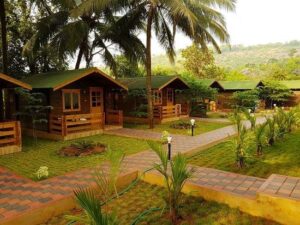
At this price, you’re building functional. Stone or brick cottages, simple interiors, a modest common area, maybe a plunge pool if you stay disciplined with the rest of the budget. Nothing that will win a design award but done right, nothing that needs to.
Resort construction cost per room in India This breakdown also helps understand the real resort construction cost per room in India, which is the most accurate way investors evaluate hospitality projects.
Per room cost at this tier: ₹8 to ₹14 lakh per room. For a 10-room property, that’s ₹80 lakh to ₹1.4 crore in construction alone before the pool, landscaping, approach road, or approvals touch your wallet.
The Kumaon hills are full of small resorts that cost under ₹80 lakh to build and run at 70% occupancy year-round. The Western Ghats have homestay style properties that started at ₹50 lakh and now turn away bookings every monsoon season.
What makes them work isn’t the construction budget. It’s the location, the experience, and the story they tell.
What doesn’t work at this price point: trying to look like something you’re not. Spend ₹1,500 per sq ft and charge ₹8,000 a night, and the guest notices the gap the moment they park their car. That gap kills OTA ratings before you’ve even found your footing.
Total realistic investment at this tier: ₹40 lakh to ₹1.5 crore for a 6 to 10 room property, fully operational.
Mid-Range Resort Construction: ₹2,500 to ₹5,000 per sq ft
This is where the most interesting resort businesses in India are being built right now and in 2026, it’s the fastest growing segment in the entire hospitality construction market.
You get a proper pool. Interiors that photograph well. A restaurant guests actively choose to eat at rather than tolerating because there’s nothing else nearby. Landscaping that makes the entrance feel like an arrival, not a parking lot.
Per room cost at this tier: ₹14 to ₹28 lakh per room. For a 15-room mid-range property, you’re looking at ₹2.1 crore to ₹4.2 crore in construction before ancillary costs. Budget ₹2.5 to ₹5 crore all-in for a finished, operational property.
More importantly, at this budget you can build around the shifts that are reshaping Indian hospitality right now. The workcation market urban professionals booking resorts for 5 to 14 days with their laptops is not a pandemic leftover. It’s a permanent behavioural shift. A mid-range resort with a dedicated co-working corner, fibre internet, and a quiet garden earns meaningfully more per room than an identical property without those things. Adding them during construction costs maybe ₹8 to ₹12 lakh. The revenue difference over three years is a multiple of that figure.
The experiential travel shift matters just as much here. A property offering a local cooking class, a guided forest walk, or a farm to table dinner concept has a story worth telling. Stories get shared. Shares drive bookings. Bookings justify the rate.
Total realistic investment at this tier: ₹1.5 crore to ₹5 crore for a 10 to 20 room property, fully operational.
Luxury Resort Construction: ₹5,000 to ₹12,000+ per sq ft
At this level, every decision is a brand decision.
The timber on the deck. The stone in the shower. The way light falls across the pool at 6 PM. The scent in the lobby. The thread count of the linen. All of it is communicating something to a guest paying ₹15,000 to ₹50,000 a night someone who is comparing you, consciously or not, to the best property they’ve ever stayed in anywhere in the world.
Per room cost at this tier: ₹35 lakh to ₹1.2 crore per room, depending on whether you’re building rooms, suites, or private pool villas. Luxury resort construction in India at this level requires hospitality architects and designers who have built in this space before not residential architects who’ve “done a few commercial projects.” The difference in outcome is not subtle.
The numbers are compelling. An ADR (Average Daily Rate) of ₹20,000 across ten villas produces ₹60 lakh in a single peak month at full occupancy. But the capital requirement, the operational sophistication, and the patience involved are equally large.
Total realistic investment at this tier: ₹5 crore to ₹50 crore and well beyond.
The Full Resort Construction Cost Breakdown: Where the Money Actually Goes
Here is what a complete resort budget looks like — not just the civil construction number that most contractor estimates lead with and most investors stop reading at.
| Cost Head | Budget Resort | Mid-Range Resort | Luxury Resort |
|---|---|---|---|
| Civil & Structural | ₹600–₹1,200/sq ft | ₹1,200–₹2,500/sq ft | ₹2,500–₹6,000/sq ft |
| Interiors & Furniture | ₹200–₹400/sq ft | ₹400–₹800/sq ft | ₹800–₹3,000/sq ft |
| MEP (Electrical, Plumbing, HVAC) | ₹150–₹300/sq ft | ₹300–₹500/sq ft | ₹500–₹1,200/sq ft |
| Swimming Pool | ₹8–₹15 lakh | ₹15–₹40 lakh | ₹40 lakh–₹1.5 crore+ |
| Landscaping & Outdoor Spaces | ₹3–₹10 lakh | ₹10–₹30 lakh | ₹30 lakh–₹1.5 crore |
| Kitchen & Restaurant Equipment | ₹5–₹12 lakh | ₹12–₹35 lakh | ₹35 lakh–₹1 crore+ |
| Approvals & Legal Costs | ₹2–₹5 lakh | ₹5–₹20 lakh | ₹20–₹75 lakh |
| Approach Road & Site Development | ₹3–₹15 lakh | ₹10–₹40 lakh | ₹30 lakh–₹2 crore |
| Staff Quarters & Back-of-House | ₹5–₹10 lakh | ₹10–₹25 lakh | ₹25–₹75 lakh |
| Pre-Opening, Branding & Marketing | ₹2–₹5 lakh | ₹5–₹20 lakh | ₹20 lakh–₹1 crore |
Look at what’s missing from most contractor quotes: approach road development, back-of-house infrastructure, pre-opening expenses, branding. These items alone routinely cause 20 to 30% cost overruns for people who didn’t account for them. Standard advice says hold a 20% contingency. My advice: hold 25% and feel genuinely relieved if you don’t spend all of it.
State-Wise Resort Construction Cost in India: Your Location Changes Everything
Resort construction cost in India is not one national number. It’s a patchwork of local labour markets, material availability, transport distances, and regulatory environments. The same 15-room resort costs meaningfully different amounts across different states.
| State / Region | Cost vs. Baseline | What’s Driving the Difference |
|---|---|---|
| Goa | +25 to 35% | Premium land, imported materials, chronic skilled labour shortage |
| Kerala | +15 to 25% | High labour costs, specialist craftsmanship, coastal zone regulations |
| Himachal Pradesh | +15 to 25% | Transport to altitude, short construction weather windows |
| Rajasthan | +10 to 20% | Heritage craftsmanship premiums, sandstone and local material costs |
| Uttarakhand | +10 to 15% | Site accessibility, monsoon construction limitations |
| Maharashtra (non-coastal) | Baseline | Strong contractor market, reasonable material costs |
| Karnataka & Tamil Nadu | –5 to +5% | Competitive contractors, solid logistics |
| MP, Chhattisgarh, Odisha | –10 to 20% | Lower labour costs, land availability, emerging tourism |
The implication is worth sitting with. A jungle lodge in Pench, Madhya Pradesh can be built for 30% less than an equivalent property in Coorg. If you’re the first quality resort in that micro-market, you own the segment by default.
The resorts that have generated the best returns in India over the last decade weren’t always in the most famous destinations. They were often in the next destination built 3 to 5 years before the crowd arrived.
Resort Construction Trends in India 2026: What’s Shifting and Why Your Budget Needs to Reflect It
These are not predictions. These are live market movements that directly affect what you should build, how you should design it, and where you should put your money during construction.
Workcation infrastructure is now a revenue line, not a perk. Properties with reliable connectivity and dedicated work spaces are charging 15 to 25% more on Monday-to-Friday bookings a segment that barely existed five years ago. Adding this during construction costs ₹8 to ₹15 lakh. Retrofitting it after opening costs more and never looks as considered.
Sustainable construction is pulling premium room rates. Solar systems, rainwater harvesting, organic kitchen gardens, zero-plastic operations — these now command 20 to 35% higher rates from a growing and vocal segment of Indian and international guests. Building green adds 10 to 15% to construction cost upfront. Over ten years of operation, it returns considerably more, both in revenue and in reduced utility bills.
Destination weddings are reshaping how smart developers brief their architects. India’s wedding market runs to thousands of crores annually, and resorts that can absorb a 100 to 150 person event while staying operational for regular guests are consistently among the most profitable properties in any region. A good lawn, a covered event pavilion, and a kitchen that scales these belong in the construction brief, not the afterthought list.
Tier 2 and Tier 3 destinations are seeing demand that supply cannot keep up with. Jawai in Rajasthan, Gandikota in Andhra Pradesh, Majuli in Assam, Chopta in Uttarakhand, Khajjiar in Himachal — these have surging search traffic, almost zero quality accommodation, and construction costs well below saturated markets. The window won’t stay open indefinitely.
Average guest stays are getting longer. Guests who once booked Friday to Sunday are now booking Wednesday to Monday. Properties designed around layered experiences — cooking, nature, wellness, local culture — are seeing average stays increase, and longer stays improve unit economics per guest acquired dramatically.
How Resort Construction in India Actually Works: Step by Step
Step 1 — Land Analysis Before You Fall in Love With the View
This is the step most investors skip because it feels like delay. It isn’t delay it’s due diligence. It’s the difference between building on land that works and building on land that looked stunning in January but has a water table issue, a right-of-way dispute with the neighbouring village, and soil that will add ₹40 lakh to your foundation.
A geo-technical survey, a legal title check, and a basic feasibility study combined cost ₹1.5 to ₹3 lakh can save you from ₹30 to ₹50 lakh of post-construction surprises at a stage when reversing course is no longer an option.
Step 2 — Design for the Guest and for the Team Running the Place
The best resort designers work backwards from two realities simultaneously: the guest’s experience and the operational demands of the staff serving them. They ask: how does a housekeeper service twelve rooms without crossing guest pathways at 8 AM? Where does laundry happen without guests seeing it? How does a delivery truck reach the kitchen without rolling through the garden?
Resorts that look extraordinary but operate chaotically will eventually show that chaos in their reviews. In 2026, reviews are distribution. A 4.2 rating on Booking.com versus a 4.7 is not an aesthetic gap it’s a 20 to 30% difference in booking conversion that compounds every single month.
Step 3 — Approvals: Give Them Time and Budget Both
Land use conversion. Building plan sanction. Tourism department registration. Fire safety NOC. Environmental clearance if you’re near forest, coast, or river. These are legal requirements not suggestions. Skip or rush them, and your finished property can be sealed before the first guest checks in.
Realistic timelines: 8 months in a straightforward case, up to 2 years in complex ones. Build this into your financial model on day one, not as a footnote on page seven.
Step 4 — Construction: The Last 10% Is What Guests Remember
Here is a pattern I’ve watched play out more times than I want to count. A developer runs full energy and nearly full budget through 90% of construction, then runs out of both for the finishing stage. The tiles in room seven are a slightly different shade from room eight. The garden path lights were never installed. The restaurant chairs are mismatched because the original order came late and nobody wanted another delay.
Guests notice. The last 10% of a resort is what they photograph, what they post, and what they write about in their reviews. It is precisely the wrong place to cut corners.
Step 5 — Soft Launch Before Full Opening
Before going fully live, run four to six weeks of invited guests at a reduced rate. Travel writers. OTA market managers. People who will give honest feedback rather than polite reassurance. There will be fifteen things you didn’t notice during construction. Find them before your paying guests do. Build your first real reviews before you’re depending on them to fill the calendar.
Your OTA ranking at month three is almost entirely shaped by your first six weeks of reviews. That is not an exaggeration it is how the algorithm works.
Is Building a Resort in India Worth It in 2026? The Real ROI Numbers
| Property Type | Total Investment | Peak Month Revenue | Off-Season Revenue | ROI Window |
|---|---|---|---|---|
| 6-room budget retreat | ₹50L–₹90L | ₹2.5–₹5L | ₹50K–₹1.5L | 4–6 years |
| 12-room mid-range resort | ₹2Cr–₹4Cr | ₹10–₹22L | ₹2–₹5L | 5–7 years |
| 15-room luxury property | ₹8Cr–₹20Cr | ₹35–₹80L | ₹8–₹18L | 6–10 years |
Three things consistently accelerate these timelines:
Food and beverage. A well-run resort restaurant adds 30 to 40% on top of room revenue. Many properties make their real margin at the dining table, not at reception.
Events and weddings. One destination wedding weekend generates what twenty regular bookings would. A resort designed even modestly to host events has a structural revenue advantage that compounds annually.
Day packages. Non-residential guests using your pool, restaurant, and activities on a Sunday afternoon are pure margin with zero room overhead. Properties that actively sell day packages are generating 15 to 20% of total revenue from guests who never spend a night.
Five Mistakes That Turn Resort Dreams Into Expensive Regrets
Choosing land for its price, not its demand. A beautifully constructed resort in a location with no organic tourist interest will spend most of its marketing budget simply explaining why guests should bother making the trip. Location is not everything but it’s closer to everything than any other single variable.
Copying a concept that belongs somewhere else. A Bali-inspired resort works in Goa. In Himachal Pradesh it looks transplanted and unconvincing. Build something that belongs where it stands drawing from local materials, local architecture, local food and you create authenticity that no catalogue of imported rattan furniture can replicate.
Underestimating monthly operating costs. Staff salaries, utilities, OTA commissions at 18 to 25%, linen replacement, maintenance reserves, insurance, property tax these arrive every month without exception. Many first-time resort owners budget construction carefully and then discover the cost of running what they built is twice what they planned for.
Building with no plan for the off-season. Every resort in India has one. The properties that survive it and the ones that fail are separated almost entirely by whether they designed for off-season revenue from the beginning. Corporate retreats, wellness programmes, school group packages, local event tie-ups these keep cash moving in July when leisure bookings slow to a crawl.
Opening without a brand. Your resort’s name, visual identity, story, and positioning should exist on paper before a single wall goes up. They inform design decisions, staff culture, pricing strategy, and every rupee you spend on marketing. Retrofitting a brand onto a finished building is possible but it’s expensive, and it always feels like putting a name badge on someone who has already been in the room for an hour.
Frequently Asked Questions
How much does it cost to build a 10-room resort in India? A budget 10-room property costs ₹80 lakh to ₹1.5 crore all-in. A mid-range 10-room resort runs ₹2 crore to ₹4.5 crore. A luxury 10-room property starts at ₹6 crore with no real ceiling beyond vision and capital.
How much does one room cost to build in a resort in India? Budget tier: ₹8 to ₹14 lakh per room. Mid-range: ₹14 to ₹28 lakh per room. Luxury villa or suite: ₹35 lakh to ₹1.2 crore per unit. These are construction-only figures pool, landscaping, common areas, approvals, and pre-opening costs sit on top.
Which state in India is most affordable for resort construction? Madhya Pradesh, Chhattisgarh, and interior Odisha consistently offer 10 to 20% below the national average on combined land and construction costs. The non-negotiable caveat: verify tourism demand independently before committing capital. Low cost in a low-demand location is not an opportunity it is a warning sign.
How long does resort construction take in India? A 6 to 8 room budget property: 10 to 16 months. A mid-range 15 to 20 room resort: 18 to 30 months. A luxury property with custom architecture: 3 to 5 years from signed brief to opening day. These timelines assume approvals are pursued in parallel with design, not sequentially after it.
What government approvals are needed to build a resort in India? Land use conversion, building plan approval from local Panchayat or municipal authority, tourism department registration, fire safety NOC, and environmental clearance if near forest reserve, coastal regulation zone, or river. Budget 8 to 18 months and ₹5 to ₹50 lakh for this stage, depending on state and site complexity.
Can agricultural land be used to build a resort in India? Yes but land use conversion approval from the state government is mandatory before construction begins. The process varies significantly by state. Rajasthan and Uttarakhand have relatively tourism-friendly conversion policies. Others require considerably more time and documentation.
What is the typical ROI on a resort in India? ROI ranges from 4 years for a well-located small property operated efficiently to 10 years for a large luxury development. Properties that actively earn from F&B, events, and day packages alongside room revenue reach profitability meaningfully faster than those dependent on room bookings alone.
What is the biggest financial mistake first-time resort investors make? Mistaking construction cost for total investment. The building typically represents 60 to 70% of what you will actually spend. Land development, approach road, approvals, pre-opening inventory, staff recruitment and training, branding, and marketing account for the rest and those line items are almost always absent from the early estimates that shape the initial decision to proceed.
The Honest Bottom Line
India’s domestic tourism market crossed 1.7 billion visits and keeps climbing. Weekend travel is a fixed habit for a large, growing urban middle class. The demand for quality, characterful, experience-led accommodation in non-metro destinations is outpacing supply and that gap is not closing quickly.
The opportunity to build a profitable resort in India in 2026 is genuine. The complexity of doing it well is equally real.
Resort construction cost in India ranges from ₹1,200 per sq ft for a simple functional retreat to ₹12,000 per sq ft and beyond for a luxury villa property. Per room, that means anywhere from ₹8 lakh to over ₹1 crore depending on what you’re building and where. The number that matters most isn’t the construction cost, though. It’s the return that investment generates over ten years and that number is shaped far more by the decisions made before construction starts than by anything that happens during it.
The investors who do this well treat it exactly like the serious, complex business it is. They run feasibility before they fall in love with the land. They work with people who have actually built in this space before. They hold contingency and are grateful when they don’t spend all of it. They plan for operations from day one, not day three hundred.
And then usually somewhere between year three and year seven they stop wondering whether it was the right decision.
Because the numbers have already answered that question.
PlanMySpaces builds resorts, villas, and hospitality properties across India. If you have land and a vision, [let’s talk about what it could become →]